French filmmaker Sylvain Chomet directs the animated feature The Triplets of Belleville. A young boy is raised by his grandmother, Madame Souza, in the French countryside. She buys him a bicycle and encourages his dream of winning the Tour de France. However, he gets kidnapped by a group of Mafia gangsters and taken to the big city of Belleville, where he is used for his bicycling prowess in an elaborate gambling scheme. Along with her faithful companion Bruno, Madame Souza sets out to rescue her grandson. They befriend a trio of aging musicians who were once the '30s jazz trio known as The Triplets of Belleville. Features an original jazz musical score by Benoît Charest. — Andrea LeVasseur
from http://www.dvdtimes.co.uk/content.php?contentid=10549
by Michael Mackenzie
Until I saw Les Triplettes de Belleville (released as Belleville Rendez-vous in the UK and The Triplets of Belleville in the US), I had never heard of director Sylvain Chomet. His previous claim to fame is La Vieille Dame et les Pigeons, a short piece of animation that displays, albeit in a more simplistic form, many of Belleville’s hallmarks. Widely marketed as a French film, this French-Belgian-Canadian co-production with partial UK funding was largely animated in a cramped office in Montréal with a skeleton crew working with outdated technology and very little room for error. The results are, quite frankly, astounding.
The story is a relatively lightweight affair, and is strictly there to support the artwork and gags rather than the other way round. Madame Souza is rigorously training her grandson, Champion, for the Tour de France. During the Tour, Champion and two other cyclists are kidnapped by members of the French Mafia and taken to the city of Belleville, a place that looks like New York, Montréal and Paris combined, where they will be made to cycle until they collapse, with members of the Mafia taking bets on who will be the only survivor. Meanwhile, with her overweight dog Bruno in tow, Madame Souza follows her grandson’s captors to Belleville and enlists the aid of three old hags who were formerly immensely popular singers (the “Triplettes” of the title).
Intriguingly, the film manages to convey information without any real use of dialogue. There are at most four lines in the entire film, and none of them play any real part in the story. The pacing is very slow, never going anywhere in hurry, and with even the more tense sequences drifting by without any real sense of urgency. As such, this is definitely going to irritate those with short attention spans, and the first time I saw it, I have to admit I felt there were moments that plodded. For me at least, however, the film definitely improved with a second viewing. When I first saw it, the deliberately slow pace worked against it, because I wanted to know what would happen next but found myself waiting too long for the results. On subsequent viewings, with a prior knowledge about what is going to happen, the film is much more enjoyable because the atmosphere, visuals and jokes can be appreciated to their full extent. In particular, a number of background jibes are much more noticeable when seen for the second time, such as a piece of excrement floating in a toilet bowl that is shaped like Mickey Mouse’s ears.
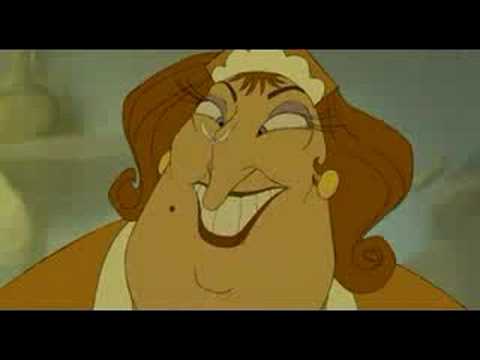
Belleville makes its influences clear. Stylistically, it adheres more to the look of the political cartoons found in broadsheets than to the overly cleaned-up look of, for example, Disney’s more recent works. The outlines of the characters are deliberately rough and penciled (recalling Disney’s Xerox period, when films like One Hundred and One Dalmatians and The Jungle Book were produced), and both the designs and movements are heavily caricatured. Much of the comedy recalls the works of Jacques Tati, and at one point a poster for M. Hulot’s Holiday can even be seen on a wall. Realism is the last thing on Chomet’s mind with this film, with all the characters and even the settings being exaggerated to the point of being bizarre, with designs that border on the grotesque. The French characters are given large noses and elongated features, and the Americans look more like over-inflated balloons than people. It definitely makes a nice change to see an animated film that embraces the fact that it is a cartoon rather than trying to ape real life. It’s definitely a world away from the bland style Dreamworks applies to all of its traditionally animated features.
It’s also nice to see a 2D-animated film in an age increasingly oversaturated by CG. That’s not to say that there isn’t any 3D animation in Belleville - vehicles and some shots of the cyclists make are computer generated - but generally they are used sparingly, and are relatively unobtrusive, even if they don’t always fit in 100% with the 2D animation. For one thing, the 3D objects lack the rough edges of the hand-drawn animation, and their movement sometimes comes across as a little too smooth and pre-planned than the often unpredictable and quirky 2D. The use of 3D was definitely a necessary evil, especially considering how small the production crew was for this film, but at times it certainly appears to be more of a time-saving device than anything: especially in the case of the cyclists, it often seems that 2D animation could have been used to better effect.
It’s actually surprisingly difficult to review a film like this. The experience is so visceral that it’s impossible to explain its impact in words. Les Triplettes de Belleville is, overall, a very interesting and unique piece of work. Les Triplettes de Belleville is, overall, a very interesting and unique film. If it doesn’t win you over the first time, persevere, because there is a lot to be appreciated from this. It manages to combine a childish curiosity with more adult cynicism, and I for one am hoping for it to snag the “Best Animated Feature” award at this year’s Oscars.


 English
  Nederlands
  Deutsch
  Français
  Español
  Magyar
  српски
  Dansk
Dansk  Italiano
  Svenska
  Slovenčina
  Português