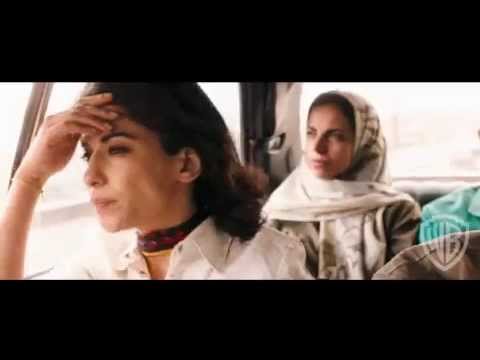
Two childhood friends are recruited for a suicide bombing in Tel Aviv.
Said (Kais Nashef) is a young Palestinian living in Nablus, and working as a mechanic. He gets his friend Khaled (Ali Suliman) a job, but the hot-tempered and impulsive Khaled quickly loses it. Suha (Lubna Azabal), a pretty, well-traveled young woman and the daughter of a well-known "martyr," brings her car in to be fixed, and flirts with Said. He's clearly interested in her, so much so that he continues to think of her when he's approached later that day by Jamal (Amer Hlehel), who tells him that he's been selected for an important mission, a suicide bombing in Tel Aviv, and that Khaled will be joining him, as they had requested. That night, Jamal stays with Said at his mother's (Hiam Abbass) house, while another man stays with Khaled. Said sneaks off during the night to bring Suha her car keys, and has a brief discussion with her about her father's death, and what options the Palestinians have in their dealings with Israel. Said doesn't tell her the real reason for his visit: he's saying goodbye. The next morning, as scheduled, Said and Khaled are given neat haircuts and suits. They each make a video explaining to their families why they've chosen this path. Explosives are strapped on, and they are warned that trying to remove the belts themselves will result in detonation. When they're brought to a hole in the fence surrounding Nablus, they are intercepted by Israeli troops. Khaled and Said flee, and get separated. Said is left on his own. Paradise Now was co-written and directed by Hany Abu-Assad (Rana's Wedding, Ford Transit). A hit on the festival circuit, it was selected for inclusion in the 2005 New York Film Festival by the Film Society of Lincoln Center.
AMG Review: Paradise Now opens strong, with a wordless confrontation at a checkpoint between an Israeli soldier and a clear-eyed Palestinian woman (who turns out to be Suha [Lubna Azabal]). In this brief, cannily shot and edited, prosaic little encounter, director Hany Abu-Assad focuses primarily on the eyes of the two characters as one tries to size the other up and the other defiantly resists being sized up. It's clear that in this quiet little seemingly inconsequential moment -- a moment that might happen a hundred times a day -- a battle is being waged, and it's a battle for something more than just a piece of land. Later in the film, there are strong moments, and weaker ones. There are scenes, like the surprisingly witty one in which two prospective suicide bombers videotape messages to their loved ones proclaiming the divinity of their actions, that cut brilliantly against our expectations. There are moments, like the scene after Said (Kais Nashef) crosses the fence, and he's contemplating boarding a bus full of Israeli settlers, in which Abu-Assad and his fine cast wordlessly take us an unresolvable gamut of human emotion, and there are others scenes wherein the dialogue seems disappointingly pedantic. But it holds together surprisingly well, and Abu-Assad finds an emotional richness in the material, while honing in on the righteous anger that springs from a life lived in humiliated futility. A tragedy regardless of its conclusion, Paradise Now is an important and powerful effort to explicate the inexplicable.


 English
  Nederlands
  Deutsch
  Français
  Español
  Magyar
  српски
  Dansk
Dansk  Italiano
  Svenska
  Slovenčina
  Português