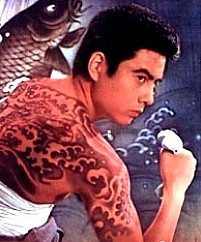
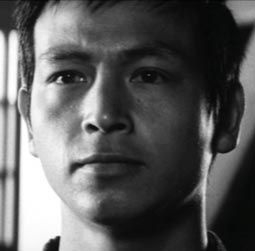
n this sharp satire from acclaimed Japanese director Seijun Suzuki, Hideki Takahashi plays Kiroku, a middle-school student who finds himself troubled by an obsessive lust for the virginal Michiko (Junko Asano), the daughter of the family with whom he boards. But Kiroku soon discovers the perfect solution to thoughts of sex -- violence. One of Kiroku's schoolmates coaches him in the manly art of self-defense, and soon he joins a gang, eagerly fighting whenever the opportunity presents itself. Michiko is troubled by Kiroku's sudden embrace of his brutal side and tries to teach him to appreciate the more gentle side of life -- which, of course, doesn't help him at all. Soon, Kiroku is thrown out of school for making trouble and is sent off to live with his uncle, where preponderance and small-town machismo allow Kiroku to find all the violence he could hope for. The Fighting Elegy's screenplay was written by Kaneto Shindo, a noted leftist filmmaker who also served as an assistant director to Kenji Mizoguchi.
All Movie Guide - Craig Butler
The Fighting Elegy is a disturbing yet beautiful film, a minor masterpiece that has a special place in the career of director Seijun Suzuki. Most of Suzuki's '60s films are marked by a wild, stunning, outrageous visual style, which overwhelms (thankfully) the sub-level genre scripts that he has to deal with, elevating what would have been traditional programmers into works of personal art. Elegy is different in that the screenplay itself has a great deal of merit and, perhaps as a result of this, Suzuki's visual style is relatively restrained. Not that he doesn't find a few opportunities to make wild statements, as in his use of alternating split screens in a classroom scene and in abrupt and sudden switches back and forth between medium shots and extreme close-ups during a sequence involving the reciting of rules. But for the most part, the visuals are much gentler and frequently gorgeous -- the manner in which leaves softly fall during the "walking home" sequence, or the lovely snow scenes (made more poignant by what is occurring during one of them). Suzuki clearly has a personal connection to the story being told, of a youth whose sexual desires are sublimated in acts of increasing violence, leading him and many others down the road to fascism in the '30s. He imbues it with enormous sensitivity, even when he is being satirical or broadly comic. As Kiroku, Hideki Takahashi is clearly too old, but he responds well to Suzuki's direction, and Junko Asano's incredible fresh-scrubbed beauty makes her ideal for Michiko. The Fighting Elegy will inevitably have a deeper meaning for Japanese audiences, but it is told with such skill that even those unfamiliar with Japan's specific history at the time or with its cultural details will appreciate it.


 English
  Nederlands
  Deutsch
  Français
  Español
  Magyar
  српски
  Dansk
Dansk  Italiano
  Svenska
  Slovenčina
  Português