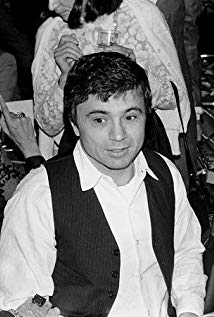
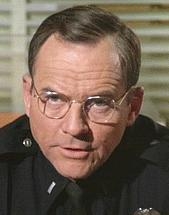
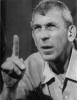
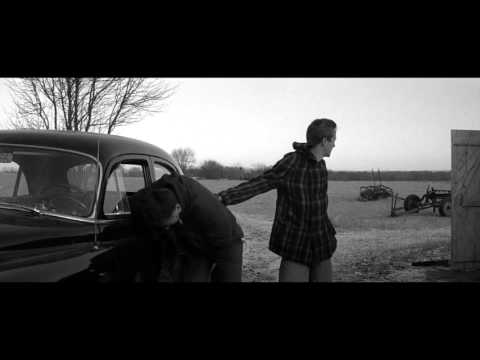
Richard Brooks wrote and directed this stark black-and-white (with brilliantly evocative cinematography by Conrad Hall) study of two drifters who murder a family, based on Truman Capote's non-fiction novel In Cold Blood. The film takes place in Holcomb, Kansas, where four members of the Herbert Clutter family are roused from their sleep and brutally murdered. The killers, Perry Smith (Robert Blake) and Dick Hickock (Scott Wilson), are two ex-cons who plan to rob the Clutters of $10,000 kept in a safe in their home. But Dick and Perry find no safe and no $10,000 and end up leaving the murder scene with only $43. The police, led by Alvin Dewey (John Forsythe) of the Kansas Bureau of Investigation, try to track down the killers. Meanwhile, Dick and Perry take off to Mexico, where Perry has fantasies of prospecting for gold. But when his dreams of prospecting come to naught, Dick insists that they return to the United States. Confident that they have left no clues, they cash bad checks, and the police track them down in Las Vegas. During questioning, their alibis are broken when they are separated and tell conflicting stories. — Paul Brenner
AMG Review: Director Richard Brooks stripped away the outer layers of literary artifice for his screen adaptation of Truman Capote's "non-fiction novel" about a multiple murder in Kansas and instead captured the book's core: a painstakingly researched and breathtakingly detailed account of a crime that had terrible consequences and no real point. Aiming for as realistic and "non-Hollywood" an approach as possible, Brooks shot In Cold Blood in stark but richly detailed black-and-white (Conrad Hall earned an Oscar nomination for his camera work) and filmed much of the action in locations where the events occurred in real life; the result is a film with the narrative strength of a well-structured drama and the unflinchingly honest look of a documentary. Brooks also wisely cast two relative unknowns in the leads; Robert Blake, who made his screen debut in 1938 at the age of 5, gave a striking breakthrough performance as the brutal but weak-willed Perry Smith, and Scott Wilson, in his second screen appearance, was just as convincing as the sly, manipulative Dick Hickock. Both actors practically disappear into their roles, delivering the finest work of their respective careers. The film also shrewdly follows the book's structure in not showing the actual murders until relatively late in the game. Brooks allows us to get to know Smith and Hickock quite well before we see their most brutal and mercenary sides, and we're also given a chance to become acquainted with the doomed members of the Clutter Family; it's ultimately the story of the killers, but the presence of the victims gives the film a greater, more tragic weight. And while Brooks avoids hitting the audience over the head with an anti-capital punishment message, the film's conclusion makes clear that the execution of Perry and Dick serves no more point than the murder of Herbert Clutter and his family: both are mistakes, with no one better off as a result. — Mark Deming


 English
  Nederlands
  Deutsch
  Français
  Español
  Magyar
  српски
  Dansk
Dansk  Italiano
  Svenska
  Slovenčina
  Português