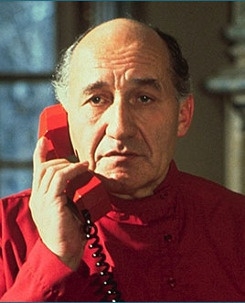
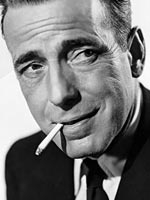
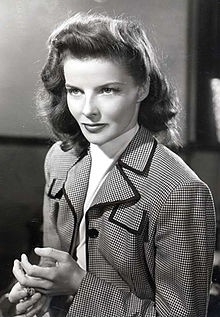
After years of wooing director John Huston via good reviews, film critic James Agee was given a chance to write the screenplay for a Huston picture. Adapted from a novel by C.S. Forester , The African Queen stars Humphrey Bogart in his Oscar-winning portrayal of Charlie Allnut, the slovenly, gin-swilling captain of a tramp steamer called the African Queen , which ships supplies to small East African villages during World War I. Katharine Hepburn plays Rose Sayer, the maiden-lady sister of a prim British missionary ( Robert Morley ). When invading Germans kill the missionary and level the village, Allnut offers to take Rose back to civilization. She can't tolerate his drinking or bad manners; he isn't crazy about her imperious, judgmental attitude. However it does not take long before their passionate dislike turns to love. Together the disparate duo work to ensure their survival on the treacherous waters and devise an ingenious way to destroy a German gunboat. The African Queen may well be the perfect adventure film, its roller-coaster storyline complemented by the chemistry between its stars. The profound difficulties inherent in filming on location in Africa have been superbly documented by several books, including one written by Katharine Hepburn . Screenwriter Peter Viertel incorporated some of the African Queen anecdotes in his roman a clef about a Huston-like director/adventurer, White Hunter, Black Heart . — Hal Erickson
_______---
Bogart starred with Katharine Hepburn in the movie The African Queen in 1951, again directed by his friend John Huston. The novel was overlooked and left undeveloped for fifteen years until producer Sam Spiegel and Huston bought the rights. Spiegel sent Katharine Hepburn the book and she suggested Bogart for the male lead, firmly believing that “he was the only man who could have played that part”.[101] Huston's love of adventure, a chance to work with Hepburn, and Bogart's earlier successes with Huston convinced Bogart to leave the comfortable confines of Hollywood for a difficult shoot on location in the Belgian Congo in Africa. Bogart was to get 30 percent of the profits and Hepburn 10 percent, plus a relatively small salary for both. The stars met up in London and announced the happy prospect of working together.
Bacall came for the duration (over four months), leaving their young child behind, but the Bogarts started the trip with a junket through Europe, including a visit with Pope Pius XII.[102] Later, the glamor would be gone and she would make herself useful as a cook, nurse, and clothes washer, for which Bogart praised her, “I don’t know what we’d have done without her. She Luxed my undies in darkest Africa”.[103] Just about everyone in the cast came down with dysentery except Bogart and John Huston, who subsisted on canned food and booze. Bogart explained: "All I ate was baked beans, canned asparagus and Scotch whisky. Whenever a fly bit Huston or me, it dropped dead."[104] The teetotaling Hepburn, in and out of character, fared worse in the difficult conditions, losing weight, and at one time, getting very ill. Bogart resisted Huston's insistence on using real leeches in a key scene where Bogart has to drag the boat through a shallow marsh, until reasonable fakes were employed.[105] In the end, the crew overcame illness, soldier ant invasions, leaking boats, poor food, attacking hippos, bad water filters, fierce heat, isolation, and a boat fire to complete a memorable film.[106]
The African Queen was the first Technicolor film in which Bogart appeared. Remarkably, he appeared in relatively few color films during the rest of his career, which continued for another five years. (His other color films included The Caine Mutiny, The Barefoot Contessa, We're No Angels, and The Left Hand of God.)
The role of Charlie Alnutt won Bogart his only Academy Award for Best Actor in a Leading Role in 1951. Bogart considered his performance to be the best of his film career.[107] He had vowed to friends that if he won, his speech would break the convention of thanking everyone in sight. He advised Claire Trevor when she had been nominated for Key Largo to “just say you did all yourself and don’t thank anyone”. But when Bogart won the Academy Award, which he truly coveted despite his well-advertised disdain for Hollywood, he said “It's a long way from the Belgian Congo to the stage of this theatre. It's nicer to be here. Thank you very much…No one does it alone. As in tennis, you need a good opponent or partner to bring out the best in you. John and Katie helped me to be where I am now”. Despite the thrilling win and the recognition, Bogart later commented, “The way to survive an Oscar is never to try to win another one...too many stars…win it and then figure they have to top themselves...they become afraid to take chances. The result: A lot of dull performances in dull pictures”.[


 English
  Nederlands
  Deutsch
  Français
  Español
  Magyar
  српски
  Dansk
Dansk  Italiano
  Svenska
  Slovenčina
  Português